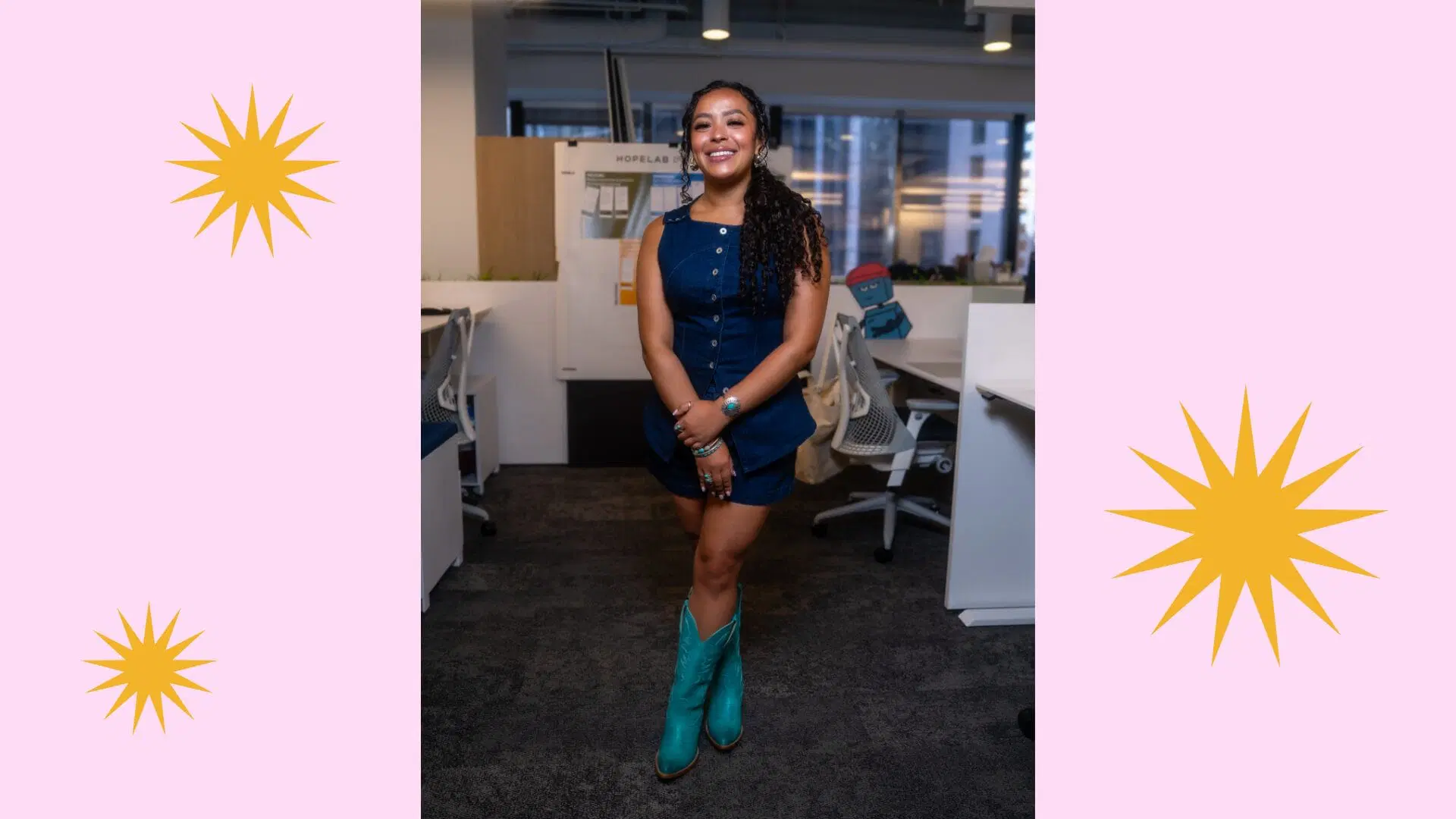
Editor’s note: This interview is part of the Hopelab series, Built by Us: Gen Z Women on Purpose, Passion & Power, and has been edited for length and clarity.
What drives you?
The young people that I serve in my community drive me. It brings me absolute joy to be with ‘my people’ and be with my community, the people who know me for who I am. Shout out to all those radical women who have molded, shaped, and put me on track to be the badass fem[inist] I am today. Shout out to the haters who doubted my capacity!
What’s the right way to give young people a seat at the table?
Ask young people what they need first; don’t assume. We all have different needs, whether it be financial compensation, leadership development, or mentorship. Families affected by police violence, for example, aren’t included in talks about victims’ compensation; they aren’t a part of that table. So set that intention and set space in the blueprint for them, their kids, and their siblings—the survivors. People with lived experience know what the fuck they’re talking about; we need to elevate that and center that a little bit more.
What does it feel like when it’s done well?
It feels liberating—like proximity to those spaces means proximity to liberation and access for young people. For me, being in those boardrooms has felt like an unexpected sense of belonging—that ‘nothing about us without us.’
When did you know you were an organizer?
I first knew I was an organizer during the pandemic—on June 2nd, 2020—when I lost my brother, Sean Monterrosa, to the Vallejo Police Department. I was immediately catapulted into the space and had to learn quickly how to organize and mobilize people for mass protests while also trying to figure out what justice even looked like.
What does justice look like in a broken system that’s operating the way it’s designed to operate?
I first saw the power of community when people showed out for Alex Nieto, [a young man who was shot and killed by four San Francisco Police Department officers on March 21, 2014]. His death sparked protests, so I always knew that there was power in community. I just never knew what that felt like until I turned my pain into purpose and power.
Tell us about the Sean Monterrosa Project.
The Sean Monterrosa Project is an initiative to not just honor my brother’s life and legacy, but to support young people who are system-impacted and system-involved coming out of juvenile hall or probation. We expose them to policy advocacy, systems work, and connect them to nature and being outdoors. We do this because we don’t talk about or see people who look like us in those spaces; doing this helps them reclaim and take up space outdoors and bring joy, healing, and advocacy into work for them.
What does reclaiming and taking up space in nature feel like for you?
Land and resources were taken from us. These things were made significantly expensive to prevent black and brown people from going outside and doing things that our ancestors had been doing for thousands of years. So, it just feels like a ‘fuck you, we’re here, and we’re not going anywhere.’
What does safety look like to you?
Being rooted in community, asking young people what they need, and helping each other out is safety. Obviously, the system isn’t working for us. I still believe safety looks like leaning into my community, my people, my elders.
What does abolition mean to you?
Being an abolitionist means not everyone’s going to understand your perspective; not everyone’s going to agree with your beliefs. For me, abolition is really just dismantling the systems that are not even doing what they should be doing and recreating something ‘for the people, by the people.’ It’s giving us what we need for safety, healing, and restoration.
What helps you avoid burnout?
Hiking, being outdoors, being with my family, and traveling. I’m a beach bum in the best way, and I think doing all of that is what keeps me out of the hamster wheel. It’s also important to have people in your community who will call you out and say, “Hey, it looks like you’re starting to get burnt out. Take a step back. Listen to your body and what you need.” I’m really grateful that I have people in my life who do that for me.
When have you felt your community’s support?
I feel really privileged and blessed to say, “I feel like that all the time.” But, I really felt community in July [2025] on the 5th annual Tucan’s Day block party in honor of my brother, Tucan—his graffiti name. We bring folks together in his name and in honor of his legacy.
What does being Latina mean to you?
I’m a first-generation Latina with immigrant parents from Argentina and El Salvador. That’s who I am; that’s how I show up at the end of the day—authentically and unapologetically me. As a Latina, I’ll lay hands and pray for you, but don’t get it twisted; I’ll throw hands, too.
What do you do at the National Collaborative for Transformative Youth Policy?
I’m doing a lot of work at the intersections of power building, mental health, and justice—specifically around police accountability and public safety. Right now, my main project is trying to integrate more police-free youth mobile responses throughout the country. I’m integrating key stakeholders from the community into this work because I have to pay it forward. There is no ‘me’ without community, and it’s only right that I hold the door open for other people to come in.
Why power building?
For me, power building looks like bringing those who are most harmed to the table. It’s opening the door for people to pull up and show up. Young people have power; we just have to unlock that shit for them. In a world where there are so many transactions, power building can be just showing up with your heart and bringing people who look like you, and bringing their stories.
Fun Facts About Ashley
Joy: cruising in lowriders and listening to oldies.
Vibe she brings to rooms: a little hyphy, a lot of joy, 100% authenticity.
Resources
• The Sean Monterrosa Project
• National Collaborative for Transformative Youth Policy