The activity is commonly run in 30–60 minutes and works well as an opening exercise for futures, strategy, or reflection sessions.
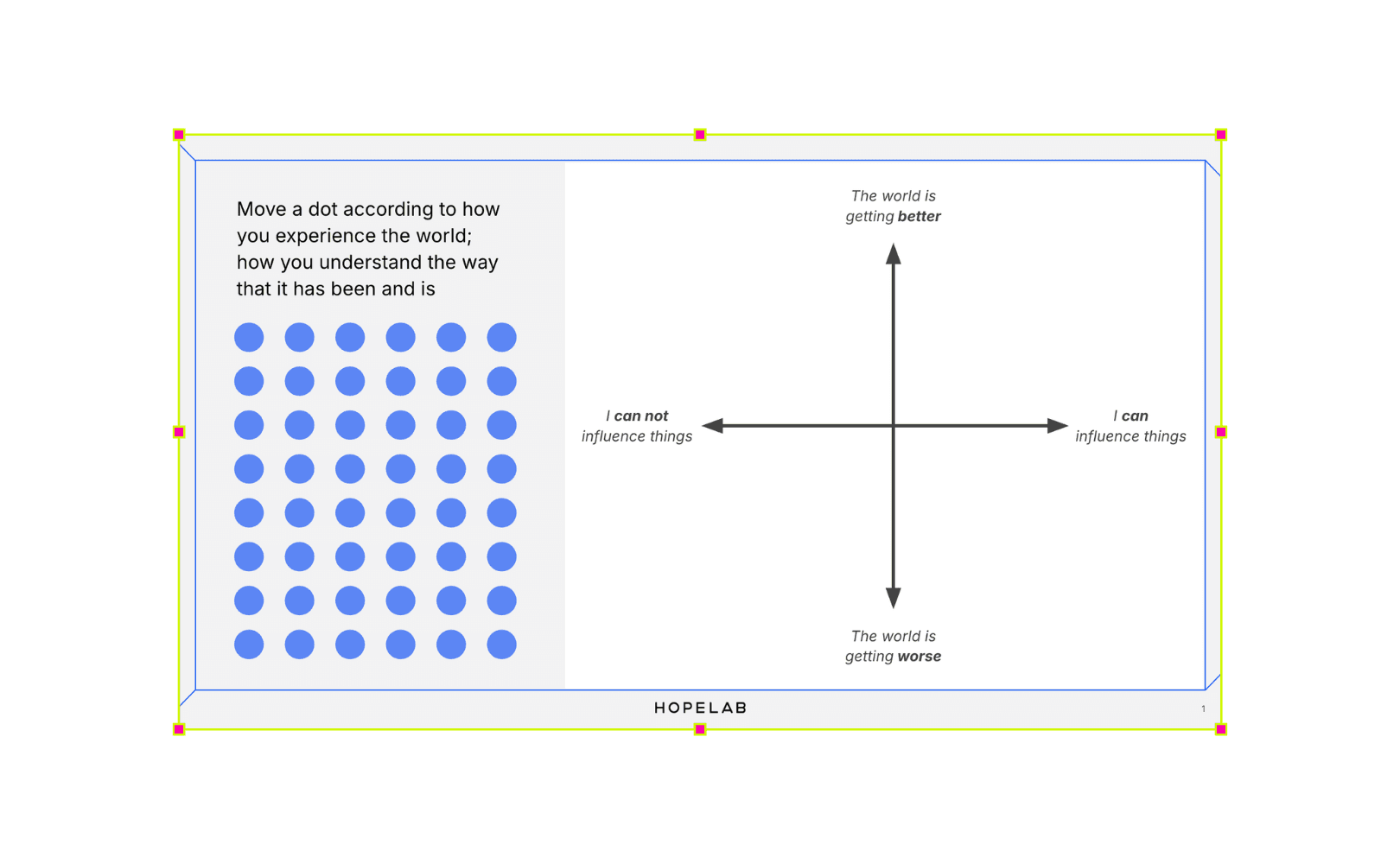
Use a shared 2×2 board where participants place their names or a dot based on two questions: how they feel about the future, and how much influence they believe people like them have to shape it. The vertical axis represents whether the future feels better or worse, and the horizontal axis represents lower to higher agency.
1. Prepare the board
Set up one shared slide or one Mural board with a large 2×2 matrix. Label the axes in a clear, simple way: top = “more hopeful / getting better,” bottom = “less hopeful / getting worse,” left = “less influence,” and right = “more influence.”
Create one movable marker for each participant using a sticky note, text box, or small shape with their name on it. Keep the board visually simple so people can focus on placement rather than design details. You can make a copy of this simple Google Slides board and invite people to move a dot to their desired quadrant.
2. Introduce the activity
Use this script:
“We’re going to do a quick mapping activity to surface how each of us is relating to the future right now.”
“This is not about right or wrong answers. It’s about noticing different assumptions, moods, and levels of agency in the group.”
“You’ll place your name on the grid based on two questions: first, whether you think the future is moving in a better or worse direction; second, how much influence you think people like you have to shape that future.”
Before people move, define the frame. For example: “Think about our field over the next five years,” or “Think about the world over the next ten years.” A shared timeframe helps people respond to the same question.
3. Invite placement
Use this script:
“First, place your name higher or lower on the board depending on how you’re feeling about the future in this timeframe.”
“Higher means you see the future trending better overall. Lower means you see it trending worse overall.”
“Then move left or right based on how much influence you think people like you have to shape that future.”
“Right means more influence. Left means less influence.”
Give people a minute or two to place themselves silently. Once everyone is in position, pause before discussion so the group can take in the overall pattern.
4. Debrief the map
Start with observation before interpretation. Ask:
“What do you notice?”
“Where do you see clusters?”
“Which parts of the map are empty or nearly empty?”
“What surprises you?”
Then move into personal reflection:
“Why did you place yourself where you did?”
“What experiences or beliefs are shaping your position?”
“What would need to change for you to move in a different direction?”
5. Deepen the conversation
If useful, invite participants to consider voices not represented in the room. This helps the group think beyond its own internal assumptions and notice who may experience the future differently.
You can ask:
“Where do you think our stakeholders or community members might place themselves?”
“Whose perspective is missing from this map?”
“What does this distribution suggest about how we approach change or possibility together?”
6. Close the activity
End with a brief reflection that connects the exercise back to the session. You can say:
“This map doesn’t tell us who is correct. It gives us a picture of how this group is currently relating to the future.”
“That matters, because our expectations and our sense of agency shape how we plan, act, and imagine what is possible.”
If you want, invite people to move their marker one final time after discussion if their thinking has shifted. That can make changes in perspective visible to the group.