Art as Practice: A Futures Salon at MoMA
What might become possible when we make a bit more room for art and imagination in our lives and work?
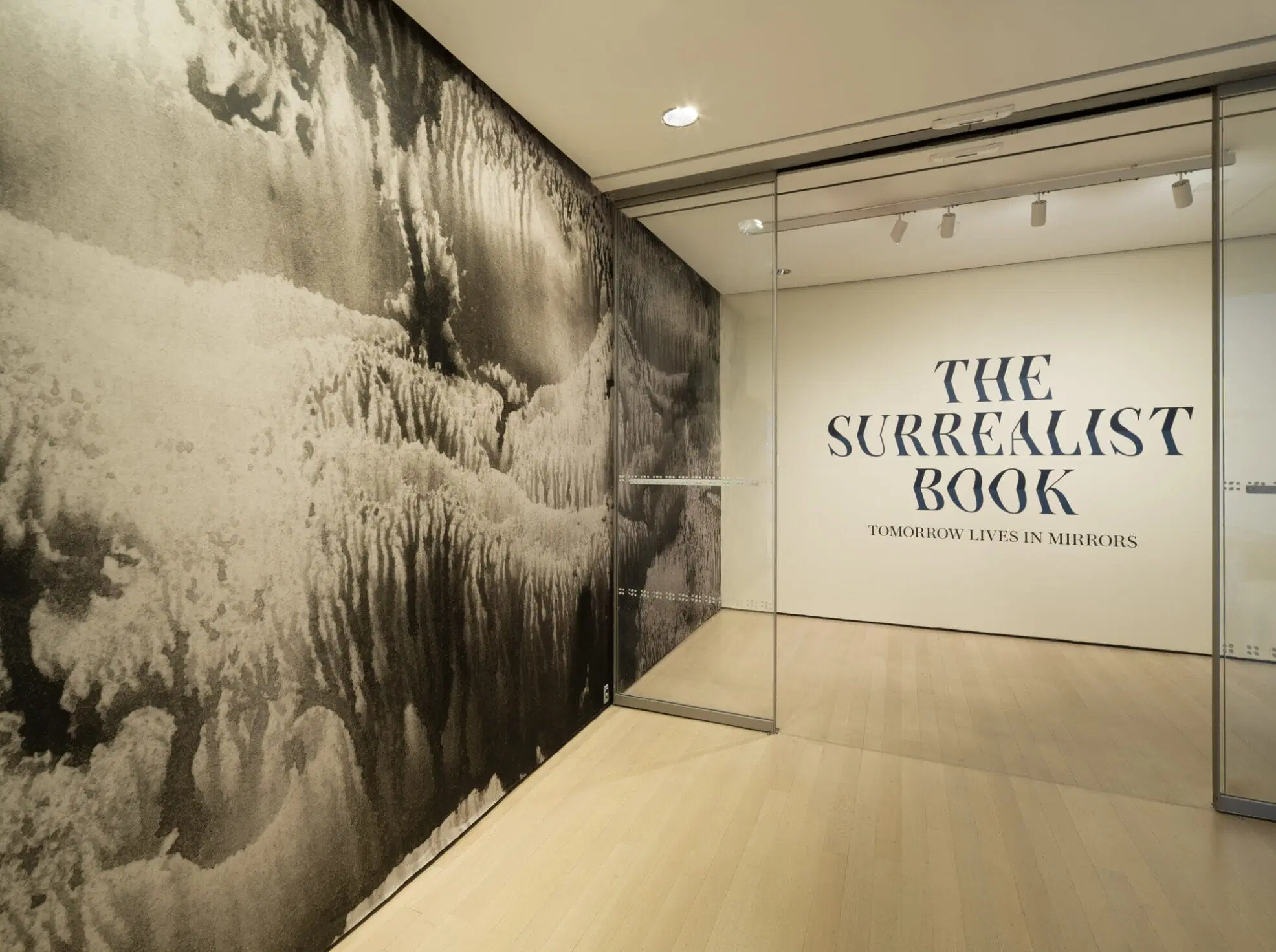
This question brought 37 artists, researchers, funders, designers, scientists, cultural practitioners, and community leaders together for Hopelab Futures’ recent salon, Art as Practice. We began at the Museum of Modern Art with a guided visit to The Surrealist Book: Tomorrow Lives in Mirrors, then continued the conversation over lunch nearby.
The gathering was designed as an unhurried experience: time to look closely, eat together, and explore curosities across disciplines.
A movement against inevitability
Surrealism emerged in Europe after the First World War, at a moment when dominant ideas about reason, progress, and social order had failed catastrophically. Artists and writers associated with the movement challenged the authority of conventional logic and social norms, turning instead toward dreams, the unconscious, chance, free association, and surprise.
While ‘Surrealism’ today might conjure thoughts of melting clocks and apples obscuring faces, this wasn’t simply an aesthetic project. Surrealism sought to remake human experience by disrupting what had been accepted as natural, fixed, or inevitable. Its artists used unexpected juxtapositions and collaborative experiments to expose the strangeness within ordinary life. Making space for other ways of seeing and being.
That orientation has much to offer for any futures practice. Futures work, at its best, is not an exercise in forecasting or prediction. It’s a practice of noticing assumptions, widening the horizon of possibility, and asking whose ideas and experiences shape the futures that seem available to us. Like Surrealism, it begins with a refusal to mistake the present for the only imaginable reality.
Books as portals
At MoMA, we encountered Surrealism through books: manuscripts, drawings, poems, photographs, unusual papers, collage, sculptural bindings, and other experiments that challenged the boundary between reading and looking. The exhibition shows how Surrealist artists and writers transformed the book from ‘content’ into an artwork and site of experimentation and collaboration.
The works in the exhibition bring together major figures including André Breton, Claude Cahun, Salvador Dalí, Paul Éluard, Max Ernst, Toyen, and Unica Zürn. They show how a book could become an arena for collaboration, an invitation to chance, or an object strange enough to interrupt habitual ways of making meaning.
For us, the exhibition was a useful prompt: What would it look like to treat the forms of our own work as open to reinvention? What changes when a research question, grantmaking process, organizational strategy, scientific inquiry, or public gathering is approached not only as a deliverable, but as a medium with its own assumptions, materials, audiences, and possibilities?
Conversation as a practice
Inspired by traditions of gathering that make room for conversation across artistic, intellectual, and social worlds, we wanted to create conditions for people with different expertise to encounter an idea together.
Over lunch, participants reflected on art as a way to practice attention, hold complexity, resist premature certainty, and stay in contact with what cannot yet be fully named. The conversations moved across fields, and a shared concern emerged: our institutions often ask us to make uncertainty disappear too quickly.
Art offers another posture. It can help us remain within ambiguity without becoming passive. It can make the familiar strange, reveal contradictions, and offer forms for feeling and thinking that precede a clear solution. It reminds us that imagination is not a luxury reserved for artists; it is an essential capacity for anyone trying to shape what comes next.
Making room
At Hopelab, we explore how to create better futures with and for young people. That work calls for research, rigor, and action. It also calls for forms of attention that help us recognize possibilities beyond what is already legible to the systems around us.
Art cannot (and in my opinion, should not) be reduced to a tool for innovation or problem-solving. Its value exceeds ‘usefulness’. Art can change the conditions under which we work: expanding what we notice, unsettling assumptions, and helping us rehearse more generous and imaginative ways of understanding one another.
Our hope for Art as Practice was simple: to make room for people who might not otherwise be in the same conversation; to encounter work that resists easy interpretation; and to leave with a renewed sense that imagination belongs at the center of the work of building futures.
The Surrealists understood that a book could be more than a book: it could be a threshold, a provocation, a portal. We left the salon carrying a version of that invitation with us – into our organizations, disciplines, communities, and daily practices.